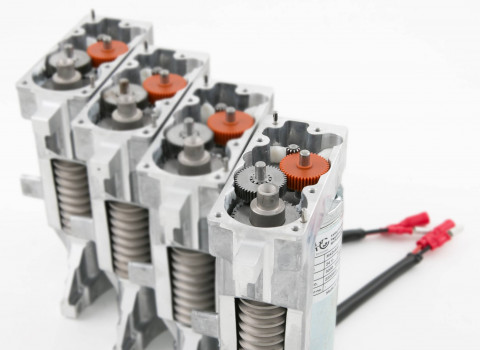
Drive systems for faster medical device deployment
29th January 2026
The UK Medicines and Healthcare products Regulatory Agency (MHRA) has released plans to launch an Early Access to Innovative Devices Programme, a new pathway designed to bring safe, effective medical technologies to patients more quickly. Here, Dave Walsha, sales and marketing director at drive system supplier Electro Mechanical Systems (EMS), explains what this programme means for medical device manufacturers and the role of motor technology in delivering reliable devices.
Built on lessons from the Innovative Devices Access Pathway (IDAP) pilot, the new scheme will allow promising medical devices to be used under time-limited, conditional authorisation, especially where they meet unmet clinical needs such as in diagnostics. Manufacturers must continue generating real-world evidence on safety and performance throughout this period.
For patients, this means earlier access to potentially life-changing equipment. For MedTech innovators, especially SMEs, the programme offers structured regulatory support, clearer milestones and a faster route to market. But speed also brings new challenges: devices must be dependable from the outset, leaving little margin for design flaws or unreliable components.
Speeding up deployment
If successful, the programme could influence how engineers approach medical device development. Devices will still need to satisfy rigorous safety standards and be practical in real-world settings — robust enough for hospitals, intuitive for clinicians and compact enough for home use. However, if early access shortens the route to initial deployment, there may be fewer opportunities for multiple design iterations before a device is placed in patients’ hands.
In this context, the performance of internal components such as motors becomes even more critical. A failure in a drive system can compromise the entire device, jeopardising its conditional authorisation and limiting the ability to generate the real-world evidence required for full approval. Reliability therefore shifts from being a design aspiration to a fundamental requirement for regulatory and clinical success.
Meeting the need for speed and precision
This focus on reliability is especially critical in compact diagnostic devices, such as micro-pumps and fluid handling systems that rely on miniature motors to move fluids precisely to ensure accurate test results in point-of-care devices and portable blood analysers. Looking at future innovations, this could extend to fully automated home diagnostic kits, wearable monitoring systems for multiple biomarkers and compact imaging tools that provide rapid, on-the-spot clinical insights.
For this technology to become reality, and for it to work dependably from day one, the drive systems powering these devices must be designed with precision and reliability at their core. Miniature motors used in medical applications are often designed to deliver consistent torque and speed across long operating cycles, while minimising vibration and heat. These are critical factors for both accuracy and patient comfort.
High-performance motors may incorporate features such as precision bearings, advanced magnetic materials, low-friction coatings and compact gearheads to maintain efficiency in small form factors. Careful thermal management and low-noise operation will also be essential to help ensure that devices can run continuously, often in close proximity to the patient, without compromising measurement accuracy or comfort.
For the MHRA’s new programme to become a reality and accelerate the route to market for medical devices, miniature motor technology must act as an enabler of next-generation performance. Collaborating closely with specialist manufacturers to supply motors that enable earlier diagnosis, more effective treatment and improved patient outcomes will play a key role in supporting the implementation of these new regulations and ultimately bringing innovative solutions to patients more quickly.
EMS is a UK-based specialist in the design and supply of precision drive systems for the medical industry. Learn more about our experience in delivering drive systems to the medical and laboratory sectors by visiting the website.